
Highest Polyphenol Olive Oil 2026: Verified Lab Results

Updated: Jul 29

By Nicolas Netien, Chief Scientific Officer and co-founder of Oleaphen. With the 2018 harvest he set the world record for the highest polyphenol concentration ever measured in olive oil, 4,943 mg/kg. He is a Knight of the Order of Agricultural Merit of the French Republic.
Quick answer
The highest polyphenol olive oil 2026 buyers can actually verify is pressed from Kalamon (Kalamata) olives picked early, while the fruit is still green. By variety, Kalamon commonly tests between 1,000 and 1,500 mg/kg total polyphenols, against 50 to 150 mg/kg for ordinary supermarket extra virgin oil.
The compound carrying most of the published research is oleocanthal, and it is the one almost no producer prints. The Oleaphen 2025/26 harvest measured 2,236 mg/kg total polyphenols and 1,248 mg/kg oleocanthal, by HPLC and LC-MS/MS at the IOC-accredited laboratory of the University of Cordoba. Supermarket extra virgin olive oil typically carries 15 to 50 mg/kg oleocanthal.
Question | Answer |
Which olive oil has the highest polyphenol content? | By variety, Kalamon (Kalamata) tests highest, commonly 1,000 to 1,500 mg/kg total polyphenols, ahead of Koroneiki, Picual and Coratina. The highest single lab-verified figure published to date is the Oleaphen 2025/26 harvest at 2,236 mg/kg total polyphenols, measured at the University of Cordoba. |
What olive oil has the most oleocanthal? | Oleocanthal sits behind most olive oil research and almost no producer lists it separately. The Oleaphen 2025/26 harvest measured 1,248 mg/kg oleocanthal. Supermarket extra virgin olive oil typically carries 15 to 50 mg/kg. |
What counts as a high polyphenol olive oil? | A high-phenolic olive oil holds at least 250 mg/kg total polyphenols, the level tied to the EU health claim under Regulation 432/2012. Ordinary supermarket extra virgin oil sits at 50 to 150 mg/kg. |
Why does the total polyphenol number mislead? | Total polyphenols sums a dozen compounds of different value. An oil can read high in total polyphenols while carrying very little oleocanthal, so the oleocanthal figure is the one to read rather than the headline total. |
Which olives have the most polyphenols? | Kalamon and Koroneiki fruit carry the most, and green unripe fruit carries far more than ripe fruit of the same variety. Phenolic content in the olive falls as the fruit turns from green to purple to black. |
How do you verify a polyphenol claim? | Look for HPLC testing to the IOC official method COI/T.20/Doc. No 29, which is the method behind the EU health claim, the oleocanthal figure on its own line, a recent harvest date, and an unbroken cold chain. qNMR is not IOC-recognised for this purpose and tends to report higher figures. |
I did not come to this from marketing. I came from agronomy and soil biology, and my speciality was dryland farming. Years ago I was hired to design an agro-ecological olive grove in Cyprus, where the brief was drought resilience: getting the trees and the soil microorganisms to work in symbiosis so the grove could thrive on very little water.
The high phenol content was an accident, a side effect of that soil work. I have spent the fourteen years since turning it into a method, developing ways to extract and preserve the oil without losing what makes it potent. The 2018 record still stands. Since then the category has grown, with many new producers and many new claims. This guide is how I read a bottle by its evidence rather than its label.
The number on the label is usually the wrong number
Total polyphenols is the figure everyone prints. On its own it is also the least useful, because it sums a dozen compounds of very different value.
The one carrying most of the science is oleocanthal, the compound behind the peppery sting at the back of your throat in a fresh, potent oil. In 2005, Beauchamp and colleagues published a paper in Nature showing that oleocanthal acts on the same COX enzymes as ibuprofen. That single finding opened one of the more productive seams in modern food chemistry, and the work has not slowed since.
A 2023 systematic review in Antioxidants searched PubMed, Web of Science and the Cochrane Library for research on oleocanthal and its biological activity, retrieved 174 records and screened 53 studies into the review.
Two decades after the Nature paper, pharmacology, food science and clinical nutrition groups across Europe and the United States are still working on this one molecule.
That research is about the compound and is the reason oleocanthal specifically is the molecule worth paying for, and it is why I keep pointing people at the guide to oleocanthal in olive oil rather than at total polyphenol counts.
Here is what most buyers never learn. Total polyphenols and oleocanthal are not the same number, and the share of the total that is oleocanthal varies enormously between oils. Oleocanthal is not present in the olive fruit at all. It forms during milling, and how much forms depends on the cultivar and on how the paste is mixed.
A good premium extra virgin oil might report 400 mg/kg total with around 50 mg/kg of oleocanthal, so roughly an eighth of the total. Oils sold as high-phenolic shots typically report more of both, and a higher share. The 2025/26 harvest measured 2,236 mg/kg total and 1,248 mg/kg oleocanthal, which is a little over half.
For context on what that share normally looks like, the same 2023 review puts oleocanthal at roughly 10% of the total phenolic content of extra virgin olive oil as a category.
That share is the number I would look at first, and almost nobody publishes enough detail to calculate it.

So a high total with no oleocanthal line is a number, not a benefit. You cannot work out the share without both.
Ask for the oleocanthal figure on its own line, by an accredited method. The Oleaphen 2025/26 certificate reports 1,248 mg/kg of oleocanthal with every compound itemised.
What makes an olive oil high in polyphenols?
Polyphenols are the antioxidant and anti-inflammatory compounds the olive tree produces to defend itself. In olive oil the main ones are hydroxytyrosol, tyrosol, oleocanthal, oleacein and oleuropein aglycone.
A high-phenolic oil generally means at least 250 mg/kg total, the level tied to the EU health claim, though the best oils reach several times higher. Under EU Regulation 432/2012, olive oil polyphenols contribute to the protection of blood lipids from oxidative stress, where the oil provides at least 5 mg of hydroxytyrosol and its derivatives per 20 g of oil, consumed daily. That is the one health claim authorised for olive oil in the EU, and it is compound-specific rather than based on the headline total.
Ordinary extra virgin olive oil usually lands between 50 and 150 mg/kg. The extra virgin grade measures acidity and processing, so it tells you almost nothing about phenolic content. If you want a practical method for assessing a bottle you already own, see how to tell if olive oil is high in polyphenols.
Which olive oil has the highest polyphenol content, by variety?
The cultivar sets the ceiling. Some varieties are naturally far richer in phenolics, and these are the ones to look for.

Kalamon (Kalamata) tops the list. Total polyphenols are commonly reported at 1,000 to 1,500 mg/kg, with a high oleocanthal share that gives the oil its bitter, peppery character. The oil is intensely pungent and the fruit yields poorly, which is why it is rarely used as a monovarietal at scale. Grown widely in Cyprus and Greece.
Koroneiki is the workhorse of Greek and Cypriot groves. The fruit is small but phenolic-dense, commonly 500 to 900 mg/kg, and rich in both oleocanthal and oleacein. It is the variety most often behind Greek high-phenolic oils.
Picual dominates Spanish production, particularly Jaen and Andalusia. It runs roughly 400 to 800 mg/kg and is prized for oxidative stability, which comes largely from its hydroxytyrosol and oleuropein content.
Coratina, from Puglia, is robust and bitter, usually 300 to 700 mg/kg, with a good oleocanthal share.
These are typical literature ranges rather than fixed values. The same variety can vary by several hundred mg/kg with harvest timing, milling and storage, so a variety tells you where the ceiling sits, not where a particular bottle landed. It is also why we use 100% Kalamon rather than blending in a higher-yielding cultivar.
Which olives have the most polyphenols?
The question people usually mean is about oil, but the fruit is where it starts, and the answer is more useful than it looks.
Two things decide it. The first is cultivar, and the ranking in the fruit broadly follows the ranking in the oil: Kalamon and Koroneiki carry more than Picual, Coratina or the high-volume Spanish and Tunisian varieties bred for yield.
The second matters more, and it is ripeness. Phenolic content in the olive falls steadily as the fruit turns from green through purple to black. A green Kalamon olive picked in late August carries a substantially heavier phenolic load than the same olive from the same tree in November. Oleuropein, the bitter compound that dominates the unripe fruit, declines through ripening, and it is the precursor pool that milling draws on.
This is why harvest date does more work than almost any other variable, and why most commercial oil is phenolically thin before it ever reaches a mill. Picking ripe fruit produces far more oil per tree. Picking green fruit produces far better oil and much less of it. Nearly every producer in the world faces that trade and most resolve it the sensible commercial way.
Table olives follow the same pattern, which is worth knowing if you eat them: green olives carry more phenolics than black ones of the same variety, though curing changes the picture considerably.
Best olive oil for oleocanthal
If your interest is specifically oleocanthal, the same early-harvest, high-phenolic varieties lead. Kalamon and Koroneiki in particular, because oleocanthal forms most readily from their precursor profile during milling.

A stronger throat sting is a reasonable sensory signal of higher oleocanthal. It is not a quantitative one, and it will not let you rank two good oils against each other, but it will reliably tell you whether an oil has meaningful oleocanthal at all. If an oil is smooth and buttery with no catch at the back of the throat, it does not.
Here is the comparison that matters, without any multiplier attached to it. Supermarket extra virgin olive oil typically carries somewhere between 15 and 50 mg/kg of oleocanthal. The 2023 Antioxidants review gives a published reference point: retail extra virgin olive oils from the United States averaging 22.6 mg/kg, against Italian oils reaching 191.8 mg/kg, with the wider commercial range running from 0.2 to 498 mg/kg depending on cultivar, harvest maturity, processing and storage.
The Oleaphen 2025/26 harvest measured 1,248 mg/kg. Both figures are on the page and you can do the arithmetic yourself.
Oleocanthal is also the compound most studied in the context of physical recovery, which is part of why high-phenolic oil has a following among endurance and combat athletes. We look at that research, and at how athletes actually use it, in high-phenolic olive oil for athletes.
Which is the healthiest olive oil with the highest polyphenols?
The honest answer is that healthiest is not a measurable property of an oil, but phenolic concentration is, and it is the closest proxy available.
The EU has authorised exactly one health claim for olive oil, and it is built on a specific compound at a specific dose: at least 5 mg of hydroxytyrosol and its derivatives per 20 g of oil, taken daily, for the protection of blood lipids from oxidative stress. That is the regulatory floor, and it is the only claim any producer in Europe can make directly.
So when you are comparing oils on health grounds, the question worth asking is how much of that compound group the oil actually delivers, and whether the figure was produced by a method that counts individual compounds. An oil at 250 mg/kg meets the threshold. The 2025/26 harvest measured 2,231 mg/kg of claim-relevant phenols, which works out to roughly 44.6 mg per 20 g, about 8.9 times the regulatory minimum.
Everything beyond that authorised claim belongs to the research literature rather than to any label, and the literature is substantial. For the mechanisms and the clinical work, see our overview of the health benefits of olive oil polyphenols and the deeper piece on 10 science-backed health benefits of high polyphenol olive oil. Two specific areas have their own coverage: olive oil polyphenols and telomeres on cellular ageing research, and olive oil benefits for women's health, hormones and menopause.
Why the testing method decides whether a number means anything
A polyphenol figure is only as good as the method behind it, and this is where most of the confusion in the category lives.
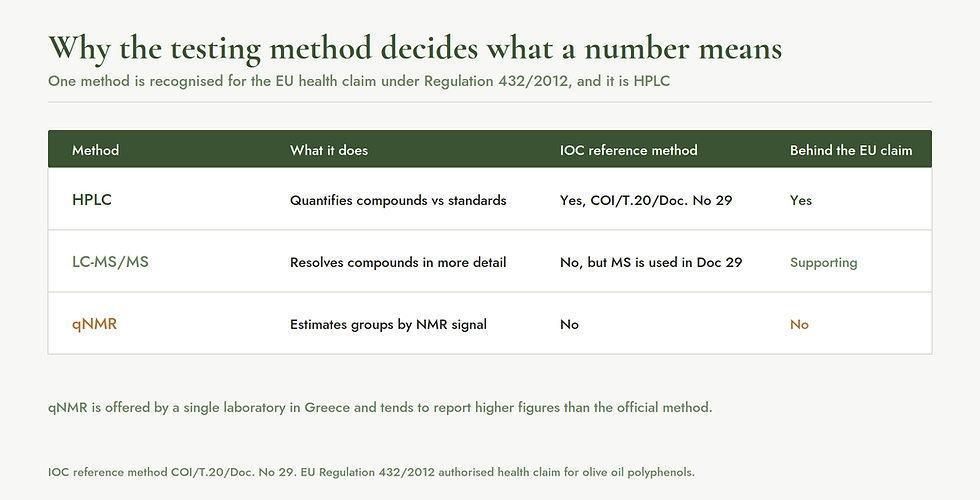
HPLC run to the International Olive Council method COI/T.20/Doc. No 29 is the official method for determining biophenols in olive oil, and it is the one behind the EU health claim under Regulation 432/2012. It quantifies individual compounds against authenticated standards, so it tells you how much oleocanthal is in the oil, how much hydroxytyrosol, how much oleacein, each on its own line.
LC-MS/MS is a more sensitive technique that resolves those compounds in greater detail. It is not the IOC reference method, and I want to be exact about that, because precision on method is the whole argument here. Mass spectrometry does appear inside Doc 29, where it is used to identify the biophenol peaks, but the quantification that carries the claim is HPLC. We run both, and the HPLC figure is the one that meets the regulation.
qNMR is a different approach, offered by a single laboratory in Greece. It is not recognised by the IOC or EFSA for this purpose, and it tends to report higher figures than the accredited methods. A number from qNMR and a number from an accredited method are not comparable, so a high figure with no method named tells you nothing at all about how the oil ranks.
Oleaphen's polyphenols are measured by HPLC and by LC-MS/MS at the IOC-accredited laboratory of the University of Cordoba, under the ARISTOIL Interreg protocol, analyst F. Priego-Capote, with a confirmation analysis at Chem Solutions in Athens. The full compound breakdown is published rather than a single total.
How the highest-oleocanthal oil is made
This is the part a marketing budget cannot copy, and it is where most of my work actually goes.
Regenerative groves, carbon negative at grove level. The groves sit across Cyprus with five farming families and are farmed regeneratively, building soil and ground cover rather than depleting them. At grove level the operation runs carbon negative, measured with the IOC carbon balance methodology. Trees grown this way go into a hard early harvest healthier, which is part of how the fruit holds its phenolic load.
100% Kalamon olives. Not a blend. Kalamon tests highest for both polyphenols and oleocanthal, and it yields far less oil per olive than the high-volume cultivars. Choosing it means a fraction of the output for a multiple of the potency.
A harvest that starts in late August/1st week of September. Most groves pick in October and November. We start in late August and run into early September, while the fruit is still green and the phenolic content is at its peak. Picking this early sacrifices yield again, and it is the single biggest reason the oleocanthal comes out where it does.
Hand-picked, then cold within minutes. Every olive is picked by hand and goes straight into a refrigerated truck at the grove, so the fruit never sits warming in the sun.
Milled within hours, under low oxygen. The olives are milled within hours of picking, through an extraction that limits oxygen exposure, because polyphenols start degrading from the moment the cells are crushed. Malaxage is where oleocanthal is made or lost, and getting it right is the part that took me years.
An unbroken cold chain to the door. The oil stays refrigerated from mill to delivery. A certificate is measured at production, and polyphenols fade with heat, light and time once the oil leaves the laboratory. Holding the chain unbroken keeps the figure you read close to the figure you swallow. On how fast that decline happens, see does olive oil lose polyphenols after opening.
Nitrogen-flushed 5 ml monodoses. A bottle meets oxygen every time it is opened, so the last serving is weaker than the first. Each monodose meets oxygen once, when you open it.

How to check any olive oil brand in two minutes
Run these on any brand, including this one, and the marketing clears fast.
Ask which method produced the number, because if it is not HPLC to the IOC official method, it is not the figure the EU claim is built on, and it may not be comparable to anything else.
Ask for the oleocanthal figure on its own line rather than just the total.
Ask how the oil was stored and shipped, since the cold chain is the difference between the certified number and the delivered one. Look for a precise harvest date, ideally early season.
Check the packaging, because a large bottle opened daily loses potency as you work through it. And compare price against verified oleocanthal content rather than per bottle, which usually changes the picture entirely.
For a worked comparison of how the named brands stack up against this checklist, see the high-polyphenol olive oil brands guide. If you are still deciding whether the category is worth the price at all, is ultra high polyphenol olive oil worth it works through the evidence.
How much should you take?
A teaspoon, about 5 ml, of a concentrated high-phenolic oil daily is a common starting point. At the 2025/26 concentration that delivers roughly 10 mg of claim-relevant phenols, about twice the 5 mg daily threshold in the EU authorised claim.

Some people take it on an empty stomach, some with a meal. The advantage of a genuinely concentrated oil is that a small volume carries a phenolic load that would take a much larger amount of ordinary oil to match. If you are thinking of taking it neat rather than cooking with it, see the guide to drinking olive oil, and for the timing question specifically, when is the best time to take high phenolic olive oil.
Frequently asked questions
Which olive oil has the most polyphenols?
By variety, Kalamon and Koroneiki oils test highest, often above 1,000 mg/kg total, against 50 to 150 mg/kg for supermarket extra virgin oil. The figure depends on harvest timing, milling and storage, so a verified lab breakdown matters more than the variety alone.
What counts as a high polyphenol olive oil?
The practical threshold is 250 mg/kg total polyphenols, the level linked to the EU hydroxytyrosol health claim under Regulation 432/2012. Premium oils run several times higher.
Which olives have the most polyphenols?
Kalamon and Koroneiki fruit carry the most, and ripeness matters more than most people expect. Phenolic content falls as the olive turns from green through purple to black, so a green olive picked in late August carries far more than the same olive picked in November.
What is the difference between total polyphenols and oleocanthal?
Total polyphenols is the sum of many compounds. Oleocanthal is one specific compound, formed during milling rather than present in the fruit, and it carries most of the published research. An oil can be high in total polyphenols and low in oleocanthal, so the oleocanthal line on the certificate is the one to read.
Why does the testing method matter for polyphenol numbers?
HPLC run to the IOC official method COI/T.20/Doc. No 29 is the recognised method for determining biophenols in olive oil, and it is the one the EU health claim is built on. LC-MS/MS resolves individual compounds in more detail but is not the IOC reference method. qNMR is not recognised by the IOC or EFSA for this purpose and tends to report higher numbers, so figures from different methods cannot be compared.
Why does high-polyphenol olive oil taste peppery?
The peppery, throat-catching sting comes from oleocanthal. A stronger sting generally signals more oleocanthal, so it is a quality cue rather than a fault.
Do polyphenols fade after the bottle is opened?
Yes. Oxygen, light, heat and time degrade them, and oxidation restarts each time a bottle is opened. A recent harvest kept cold and sealed holds its level far better, which is why single-dose oxygen-free packaging matters.
How much high-polyphenol olive oil should I take daily?
About 5 ml is a common starting point. Under EU Regulation 432/2012 the authorised claim requires at least 5 mg of hydroxytyrosol and its derivatives per 20 g of oil, taken daily. At 2,231 mg/kg of claim-relevant phenols, a 5 ml dose delivers roughly 10 mg.
Sources
Commission Regulation (EU) No 432/2012 of 16 May 2012 establishing a list of permitted health claims made on foods. Official Journal of the European Union, L 136, 1-40. Authorised claim: olive oil polyphenols contribute to the protection of blood lipids from oxidative stress.
Beauchamp GK, Keast RSJ, Morel D, Lin J, Pika J, Han Q, Lee CH, Smith AB, Breslin PAS. Phytochemistry: ibuprofen-like activity in extra-virgin olive oil. Nature. 2005;437(7055):45-46. doi:10.1038/437045a
Gonzalez-Rodriguez M, Ait Edjoudi D, Cordero-Barreal A, Farrag M, Varela-Garcia M, Torrijos-Pulpon C, Ruiz-Fernandez C, Capuozzo M, Ottaiano A, Lago F, Pino J, Farrag Y, Gualillo O. Oleocanthal, an antioxidant phenolic compound in extra virgin olive oil (EVOO): a comprehensive systematic review. Antioxidants. 2023;12(12):2112. doi:10.3390/antiox12122112. PMID 38136231
Diamantakos P, Ioannidis K, Papanikolaou C, Tsolakou A, Rigakou A, Melliou E, Magiatis P. Influence of harvest time and malaxation conditions on the secoiridoid profile of olive oil. Antioxidants. 2020;9(11):1106. doi:10.3390/antiox9111106
International Olive Council. Determination of biophenols in olive oil by HPLC. Official method of analysis, COI/T.20/Doc. No 29/Rev.1 (2017).
International Olive Council. Trade Standard Applying to Olive Oils and Olive-Pomace Oils. COI/T.15/NC No 3/Rev. 17.
Universidad de Cordoba, IOC-accredited laboratory (ARISTOIL Interreg Mediterranean protocol, analyst F. Priego-Capote). Oleaphen 2025/26 harvest analysis, HPLC and LC-MS/MS.
About the author
Nicolas Netien is Co-founder and Chief Scientific Officer of Oleaphen, a producer of ultra-high phenolic olive oil grown from 100% Kalamon olives across family groves in Cyprus, farmed regeneratively and carbon negative at grove level by the IOC carbon balance methodology. Trained in agronomy and soil biology with a background in dryland farming, he was hired to design an agro-ecological olive grove in Cyprus, where work on the symbiosis between olive trees and soil microorganisms led to a method for maximising the phenolic content of the fruit. He has spent the fourteen years since on the cultivation, extraction and preservation behind it. With the 2018 harvest he set the world record for the highest polyphenol concentration ever measured in olive oil, 4,943 mg/kg, and he was made a Knight of the Order of Agricultural Merit of the French Republic for his work.

