
How Long Does Olive Oil Last After Opening? Polyphenol Loss

Updated: Jun 26


By Nicolas Netien, Chief Scientist at Oleaphen. He has spent fifteen years on the science of high phenolic olive oil, from soil biology and cultivation through to extraction, and has advised producers across the industry. He is a Knight of the Order of Agricultural Merit of the French Republic and holds the world record for the highest polyphenol concentration ever measured in olive oil, 4,943 mg/kg, set in 2018.
Yes, and faster than most people realise.
Once a bottle is opened, oxidation begins immediately. The most bioactive compounds, oleocanthal and oleacein, are also among the most unstable. Under typical storage conditions, studies have shown declines of 60 to 75 percent in these compounds over time, meaning the functional value of the oil drops far faster than total polyphenol numbers suggest.
Even under conditions that underestimate real-world use, degradation is measurable within weeks. A 2022 study recorded a up to 18 percent drop in olive oil polyphenols after opening within just 30 days.
A 2025 study under real-world light exposure found that olive oil lost its extra virgin classification within 28 to 35 days.
These figures already assume relatively controlled conditions. In real kitchens, where bottles are opened multiple times per day, exposed to temperature fluctuations, and consumed slowly, the rate of degradation typically accelerates further.
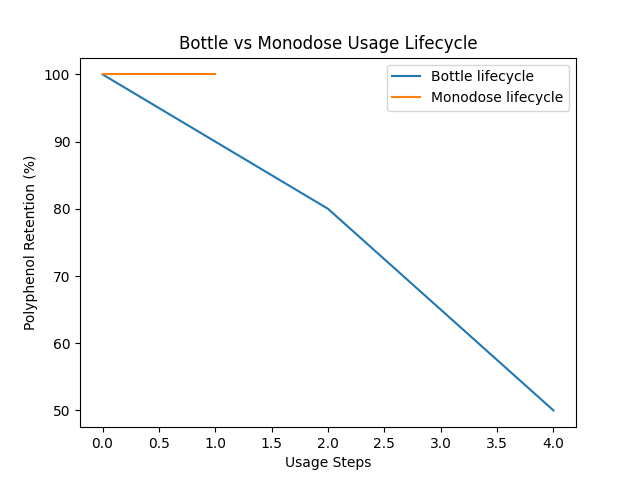
The mechanism is cumulative. Each opening introduces fresh oxygen, and as the bottle empties, the growing headspace exposes the remaining oil to progressively larger volumes of air. By the halfway point, the oil is sitting under several times more oxygen than at first opening, pushing oxidation into a higher-rate regime.
What begins as a gradual decline becomes an accelerating one.
By six months of typical use, the polyphenol profile of an opened bottle bears little resemblance to the figure printed on the label.

Quick answer table: what destroys polyphenols fastest
Factor | Impact on polyphenols | Notes |
Repeated bottle opening | Severe | Each opening introduces fresh oxygen and grows the headspace |
Light exposure | Severe | Causes EVOO grade declassification within 28 to 35 days of daily use |
Oxygen contact | Severe | Headspace above 10 percent of bottle volume increases oxidation rate substantially |
Heat (above 20 °C) | High | Degradation rate roughly doubles for every 10 °C temperature rise |
Time alone (sealed) | Moderate | Properly sealed and stored, losses remain below 10 percent for many months |
Nitrogen-flushed sealed unit | Negligible | Phenolic loss stays in the 2 to 5 percent range |
The headline finding from the literature: it is not time that destroys polyphenols, it is exposure. A bottle opened daily over six months loses far more than a sealed bottle stored for the same period.

Why oxidation begins the moment you open the cap
Olive oil polyphenols are reactive molecules by design. The same chemical structures that scavenge free radicals inside the human body also react readily with oxygen in the kitchen. The rate of degradation increases with both oxygen availability and the concentration of reactive compounds. As oxygen exposure rises, so does the speed of the reaction.[1].
When a bottle is sealed at packaging, the oil sits below a small headspace of air that quickly equilibrates. Once that initial reaction completes, very little further degradation occurs while the seal holds. This is why a closed bottle of properly handled olive oil can sit for a few months with minimal phenolic loss.
Opening the bottle changes everything. Three things happen simultaneously:
The headspace fills with fresh atmospheric oxygen. The oil surface that contacted the previous, partly depleted air now sits beneath a new, full reservoir of reactive gas. Each pour pulls oil away and replaces the volume above with more air. By the time a 500 ml bottle is half empty, roughly 250 ml of air sits over the remaining oil, in continuous contact through every minute of storage. Every replacement of the cap traps a new volume of oxygen against the surface. This is why oxidation is not a single event but a multiplying one.
Industry literature has quantified this directly. Headspace volumes above 10 percent of bottle capacity increase oxidation rates several-fold compared to minimal-headspace conditions [2]. By the time a bottle is half consumed, the oil is no longer operating under the conditions it was bottled in, it is sitting beneath a large, continuously replenished oxygen reservoir.
At that point, oxidation is no longer a slow, surface-limited process. It becomes a sustained reaction driven by constant oxygen availability, with each opening reinforcing the cycle.
What happens to olive oil polyphenols after opening: the research
The most directly applicable study to home use is Klisović and colleagues, published in the Journal of Food Composition and Analysis in 2022 [3]. The team simulated domestic consumption by opening EVOO bottles daily, removing oil weekly, and shaking between uses to mimic realistic kitchen behaviour.
After just 30 days, total phenolic content had decreased by 12.3 percent in one variety and 17.6 percent in the other. Volatile aroma compounds dropped by approximately 19 percent. The starting point for these losses was day one of opening, not month six.
A 2025 study by Alimi and colleagues, published in European Food Research and Technology [4], extended this work to nine weeks under light-exposed and dark-protected conditions. The light-exposed bottles failed EVOO classification within 28 to 35 days.
By week eight, peroxide values had reached intense rancidity (≥3.5), rendering the oil unsuitable for consumption. Light-protected bottles fared better but still showed downgrade to virgin grade by week 7 to 8. The protective effect of darkness was real but partial. Oxygen contact through repeated opening continued degrading the oil even when light was excluded.
A 2025 study by Blasi and colleagues at the University of Perugia [5] tracked phenolic compounds over twenty-four months under light and dark storage. Oleacein dropped by approximately 75 percent. Oleocanthal dropped by approximately 60 percent. Lignans and flavonoids fell by similar magnitudes. These figures are among the largest losses recorded in the recent literature for any food bioactive across realistic storage conditions.
The 2024 paper in Sustainable Food Technology recorded declines of olive oil polyphenols after opening of up to 36 percent under light exposure and 33 percent under oxygen exposure within six months [6]. The same study showed that nitrogen-flushed samples lost only 2 to 5 percent over the identical period. The protective effect of removing oxygen was approximately tenfold.
Across all studies, the same pattern emerges: measured losses in total phenolics are moderate in the early stages, but compound-level degradation and quality markers decline more rapidly. Crucially, these experiments simulate controlled usage. Real-world handling, frequent opening, larger headspace, and temperature variability, pushes the system beyond these baseline conditions, meaning the published figures are better understood as conservative estimates rather than upper bounds.
The traditional advice of "store in a cool dark place" is partially correct and badly incomplete. Light and heat matter, but they are not the dominant variables once the bottle is open. Oxygen is.
Does dark glass solve the problem?
Partially. Amber and dark green glass blocks visible and ultraviolet light effectively, and the Alimi 2025 study showed light-protected bottles preserving EVOO grade roughly twice as long as light-exposed equivalents under daily-opening conditions [4]. This is real protection.
But dark glass does nothing about oxygen. The headspace fills the same way. The repeated opening introduces the same fresh air. The pseudo-first-order oxidation kinetics run at the same speed. Dark glass slows the photo-oxidation pathway and leaves the autoxidation pathway untouched. For a bottle opened daily, the autoxidation pathway is the dominant one.
This is why high-polyphenol producers selling in dark glass bottles still face the same fundamental problem: protecting against light without protecting against oxygen halves the threat, not eliminates it.
How long does olive oil stay potent after opening?
The honest answer is that the curve depends on what was in the bottle to start with. A supermarket EVOO at 100 mg/kg has very little polyphenol content to lose. A high-polyphenol oil at 2,000 mg/kg has twenty times the absolute mass of compounds that can be oxidised, and the oxidation reactions consume that pool quickly.
Approximate timelines under typical home conditions, daily use, amber bottle, room temperature:
Days 1 to 7.Oxidation starts immediately, even if it is not yet obvious on paper. The first headspace equilibrates, but this is not a stable state, it is the beginning of repeated oxygen exposure. Each opening resets the system with fresh air, laying the groundwork for cumulative degradation.
Weeks 2 to 4.Losses become measurable. Under simulated household use, Klisović 2022 recorded up to18 percent drop in total phenolics within 30 days [3]. This is under controlled conditions. In real kitchens, where bottles are opened more frequently, the effective exposure is higher.
Month 1.Quality degradation is no longer theoretical. The Alimi 2025 study showed that under light exposure, oils lost extra virgin classification within 28 to 35 days [4]. This is not just chemical change, it is regulatory downgrade. Even in darkness, oxidation continues through oxygen contact alone.
Months 1 to 2.Acceleration becomes visible. As the bottle empties, the headspace expands, increasing the oxygen-to-oil ratio dramatically. The system shifts from initial equilibration to sustained oxidation. Secondary markers such as K232 begin rising, signalling structural degradation of the oil.
Months 3 to 6.Compound loss dominates. Multiple studies converge on 30 to 60 percent reductions in key phenolics under realistic storage conditions [5, 6]. This is where the gap between label value and actual intake becomes large. The oil still looks usable, but its biochemical profile is substantially altered.
A buyer paying for verified polyphenol content in a standard bottle is paying for a laboratory measurement taken under sealed conditions, then consuming a product that progressively departs from that value with each use. The decline is not uniform: the compounds that define the oil’s biological activity are among the first to degrade.
The result is a structural mismatch between how the product is measured and how it is consumed.

How consumers accidentally accelerate the loss
A few patterns are common across home use and they all multiply the published degradation rates:
Buying large bottles to "make it last." A 750 ml or 1 L bottle consumed slowly spends most of its life under a large headspace. The slower the consumption, the longer the air contact per volume of oil. Counter-intuitively, the bottle bought to last is the bottle that loses most of its polyphenols before being finished.
Storing on the counter, near the stove or above the oven. Olive oil stability is temperature-sensitive. Stocchi and colleagues established that oxidation kinetics roughly double for each 10 °C rise [7]. A bottle stored at 30 °C degrades at approximately twice the rate of one at 20 °C.
Decanting into a small dispenser. Some consumers decant from the master bottle into a smaller pourer for daily use. This doubles the oxygen contact: the master bottle is reopened to refill the dispenser, and the dispenser itself sits with a high headspace ratio.
Buying high-polyphenol oil and consuming it ceremonially in small daily doses from a regular bottle. This is the worst case combination. The high price per unit encourages slow use. Slow use means longer air contact. Longer air contact means more degradation. The premium turns into a discount on what actually reaches the body.
Why this matters more for high polyphenol olive oil
Premium olive oil buyers are paying for compounds, not calories. The whole proposition of a 2,000 mg/kg oil over a 100 mg/kg oil is the bioactive load: oleocanthal, oleacein, hydroxytyrosol, oleuropein derivatives, lignans. These are precisely the compounds that take the largest hits in the storage literature.
The consequence is uncomfortable but specific. A buyer paying for verified polyphenol content stored in a standard bottle is paying for the lab number on day one and consuming a progressively reduced version through the rest of the bottle's life. The certified concentration is preserved only at the moment of bottling. By month four, by month five, by the final pour, the concentration has dropped by an amount the buyer cannot see, smell, or measure without a laboratory.
This is the central problem in the high-polyphenol category. The packaging format inherited from culinary-grade olive oil is not designed to preserve bioactive compounds. It was designed for cooking fat that does not depend on phenolic stability for its value. Applying it to a product where phenolic content is the entire proposition is a mismatch.
The question is no longer whether an oil starts high in polyphenols, but whether it remains high at the moment it is consumed.
How Oleaphen approaches this
Oleaphen was designed around this problem from the beginning. The verified polyphenol concentrations of the 2025 Cypriot harvest are 2,236 mg/kg total polyphenols and 11,636 mg/kg total bioactive compounds, including 1,248 mg/kg of oleocanthal alone, all measured by LC-MS/MS at Universidad de Córdoba, an IOC-accredited laboratory [8].
The harvest is conducted early, while olives are still green and secoiridoid concentrations are at their peak. Refrigerated trucks operate inside the groves so olives are cooled the moment they leave the tree. The fruit travels chilled from grove to mill. Extraction uses a proprietary cold method developed in-house. After extraction, the oil is held under refrigeration before shipping, which is uncommon in the industry.
The packaging is the part that matters most for everything described above. The oil is portioned into nitrogen-flushed monodoses, sealed at the point of packaging and opened only at the moment of consumption. There is no headspace growing over weeks. There is no daily re-introduction of fresh oxygen. There is no second pour, third pour, fortieth pour from the same container. Each monodose holds a single dose under inert atmosphere until use. The certified concentration that left the lab is the concentration that reaches the body.
The Sustainable Food Technology 2024 data quantifies the effect directly. Under nitrogen-flushed sealed conditions, total phenolic loss over six months was 2 to 5 percent. Under typical light or oxygen exposure, the loss was 33 to 36 percent. The difference is approximately tenfold [6].
Applied to the Oleaphen oil specifically: a bottle of 2,236 mg/kg oil consumed over six months under typical home conditions would deliver a final pour of roughly 1,400 to 1,500 mg/kg. The same oil delivered through monodoses preserves approximately 2,100 to 2,200 mg/kg through the entire consumption period.
This is why monodoses exist. Not for novelty, not for portion control, but to solve a measurable degradation problem that the rest of the category has not addressed.
The 2025 harvest sold out across thirty-one countries within weeks of release. The October 2026 harvest is currently waitlisted.
Frequently asked questions
Does olive oil go rancid after opening?
Yes, and faster than most consumers realise. Rancidity in olive oil is the result of oxidation reactions between unsaturated fatty acids and oxygen, producing peroxides, aldehydes and ketones. The Alimi 2025 study found light-exposed amber bottles under daily-use conditions reached intense rancidity (peroxide value ≥3.5) within eight weeks [4]. Dark-protected bottles took longer but still degraded. The rate depends on light, oxygen, temperature and frequency of opening, all of which compound rather than substitute for one another.
Should I refrigerate olive oil?
Refrigeration slows the oxidation kinetics by approximately half for every 10 °C reduction. The Mailer 2015 study on long-term storage at 5, 15, 25 and 50 °C found degradation rate similar at 5 and 15 °C but considerably faster at 25 °C and far faster still at 50 °C [9]. Refrigeration is therefore protective for sealed bottles. For frequently opened bottles, the dominant problem is not temperature but headspace oxygen, so refrigeration helps but does not solve it. Some buyers find refrigerated oil cloudy and inconvenient, which limits the practical value.
Does dark glass alone preserve polyphenols?
No. Dark glass blocks light effectively, and the Alimi 2025 study showed light-protected bottles maintained EVOO grade roughly twice as long as light-exposed bottles under daily-use conditions [4]. But dark glass does nothing about oxygen. Once a bottle is opened daily, autoxidation through headspace contact becomes the dominant degradation pathway and dark glass cannot prevent it.
How long after opening is olive oil still useful?
For conventional EVOO consumed within four to six weeks of opening, most of the original quality remains. For high-polyphenol oil where the bioactive load is the whole point, the meaningful window is shorter because the compound losses outpace the simpler quality decline. The Klisović 2022 study measured 12 to 18 percent total phenolic loss in just 30 days under simulated home conditions [3]. After three months, the gap between certified and actual concentrations becomes substantial.
Is freezing olive oil a good preservation method?
Frozen olive oil resists oxidation effectively, but the practical drawbacks are significant. The oil solidifies at refrigerator temperatures and freezes solid at -10 °C, requiring extended thawing for each use. Repeated freeze-thaw cycles can also introduce moisture from condensation. For unopened bottles intended for long storage, freezing is defensible. For daily-use bottles, it is not practical and does not solve the underlying problem of headspace oxygen on each opening.
Read next
For the broader question of how to verify high-polyphenol olive oil in the first place: How to Tell If Olive Oil Is High in Polyphenols? (4 Things to Check Before Buying). For the underlying chemistry of what these compounds actually do: What Are Polyphenols in Olive Oil? The Complete Scientific Guide. For verified rankings across producers: Top High Polyphenol Olive Oil Brands Compared (2026 Lab Results). For the question of whether the premium is justified: Is High Polyphenol Olive Oil Worth It?.
References
Choe E, Min DB. Mechanisms and factors for edible oil oxidation. Comprehensive Reviews in Food Science and Food Safety. 2006;5(4):169-186. DOI: https://doi.org/10.1111/j.1541-4337.2006.00009.x
Stocchi G, et al. Influence of headspace oxygen on quality and shelf life of extra virgin olive oil during storage. LWT - Food Science and Technology. 2020;120:108910. DOI: https://doi.org/10.1016/j.lwt.2019.108910
Klisović D, Novoselić A, Lukić I, Brkić Bubola K. Extra virgin olive oil under simulated consumption conditions: Evaluation of quality, health, and flavour properties. Journal of Food Composition and Analysis. 2022;110:104570. DOI: https://doi.org/10.1016/j.jfca.2022.104570
Alimi S, Rodrigues N, Veloso ACA, Cruz R, Khemakhem M, Pereira JA, Casal S, Peres AM. Influence of household conditions on the shelf-life and polyphenolic-related health claim of Cobrançosa extra virgin olive oil. European Food Research and Technology. 2025. DOI: https://doi.org/10.1007/s00217-025-04743-9
Blasi F, Ceccarini MR, Bistarelli S, Galli F, Cossignani L, Bartolini D, Ianni F. Impact of Extra-Virgin Olive Oil Storage Conditions on Phenolic Content and Wound-Healing Properties. Foods. 2025;14(12):2104. DOI: https://doi.org/10.3390/foods14122104
Stability of target polyphenols of leaf-added virgin olive oil under different storage conditions over time. Sustainable Food Technology. 2024. DOI: https://doi.org/10.1039/D4FB00068D
Esposto S, et al. Temperature dependence of oxidation kinetics of extra virgin olive oil and shelf-life prediction. Foods. 2020;9(3):292. DOI: https://doi.org/10.3390/foods9030292
Universidad de Córdoba LC-MS/MS analysis of Oleaphen 2025 Cypriot harvest. Batch certificate available at: https://www.highphenolic.com/2025-analysis
Krichene D, Salvador MD, Fregapane G. Stability of virgin olive oil phenolic compounds during long-term storage (18 months) at temperatures of 5-50 °C. Journal of Agricultural and Food Chemistry. 2015;63(30):6779-6786. DOI: https://doi.org/10.1021/acs.jafc.5b02187

